
Learn how the cue-ball's path changes after contacting an object ball. This lesson introduces the 90° Rule for stun shots, the 30° Rule for forward rolling shots, and explains how the cue-ball's rotation at impact determines its path for position play.
Before We Begin
The table cloth does more than simply slow the balls down. As a ball rolls or slides across the cloth, friction continuously changes both its speed and rotation. A sliding cue-ball will eventually develop natural roll, while backspin and sidespin gradually diminish as the ball travels. Nearly every cue-ball control concept in pool is influenced by this friction, making it an important factor to understand throughout this lesson.
When the cue-ball contacts an object ball, each ball travels along predictable paths. Understanding these paths is the foundation of cue-ball control.
Every shot can be broken down into a few simple reference lines. Learning to recognize these lines is the foundation of cue-ball control and will make it easier to predict where both balls will travel.
Learning to recognize and visualize these lines will help you predict the paths of both the cue-ball and object ball. As your skills improve, identifying these lines should become a natural part of your pre-shot routine on every shot.
90° Rule
The 90° Rule states that when the cue-ball contacts an object ball during a stun shot, its new cue-ball path will initially follow the tangent line, which is always perpendicular (90°) to the shot line.
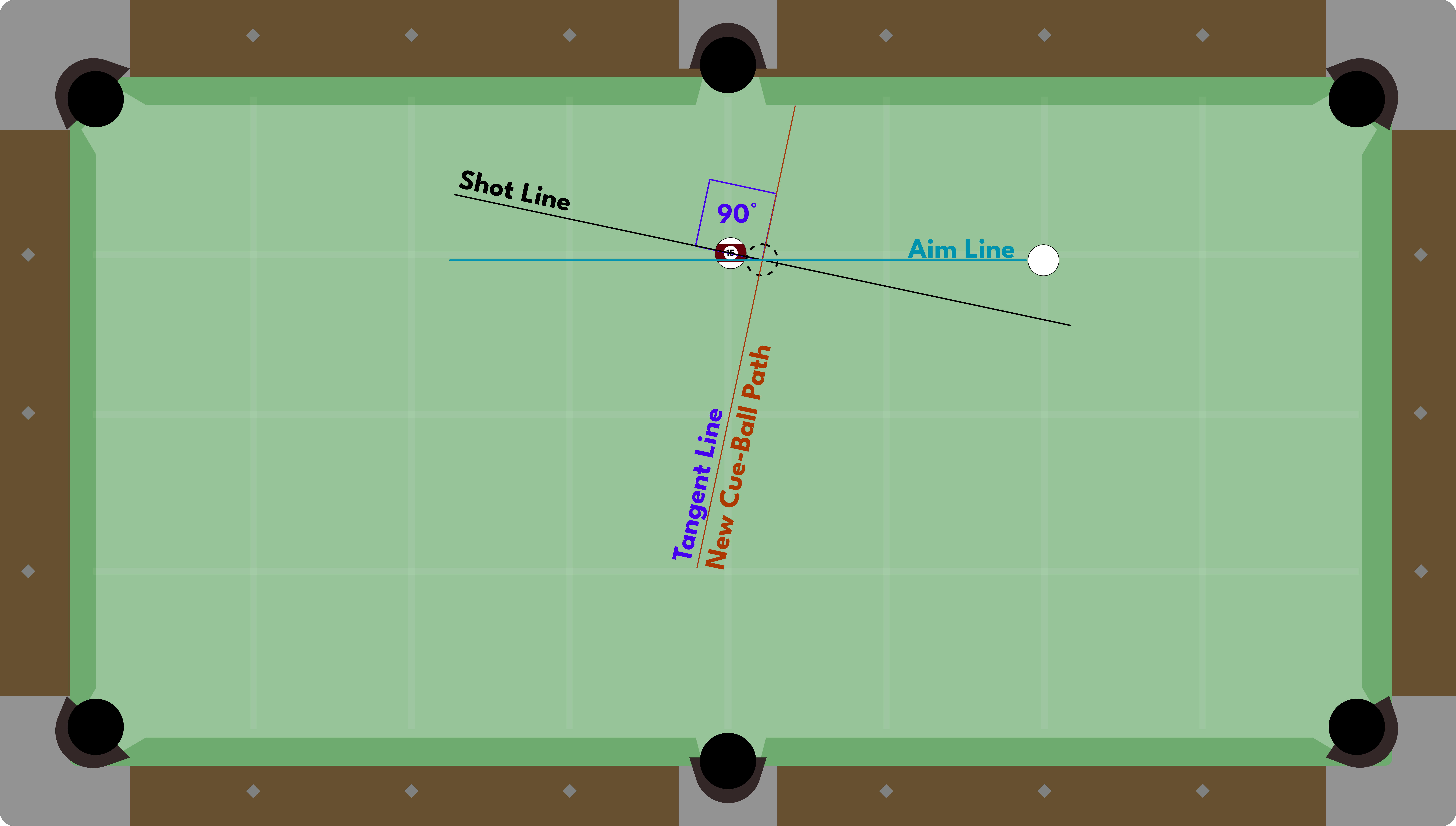
To estimate 90° during a shot, make an "L" shape with your index finger and thumb, then place the point where your fingers meet over the . Align one finger with the shot line and point the other away from the cue-ball. The finger pointing away from the cue-ball represents the tangent line, which is the cue-ball's new path after contact on a stun shot.
The 90° Rule is one of the most reliable tools in pool because it allows you to predict the cue-ball's initial direction after impact. However, it only describes the cue-ball's path while it is sliding. As you'll learn later in this lesson, a naturally rolling cue-ball follows a different path, known as the 30° Rule.
30° Rule
The 30° Rule states that when the cue-ball contacts an object ball while rolling forward, its new cue-ball path will initially depart at approximately 30 degrees from the aim line.
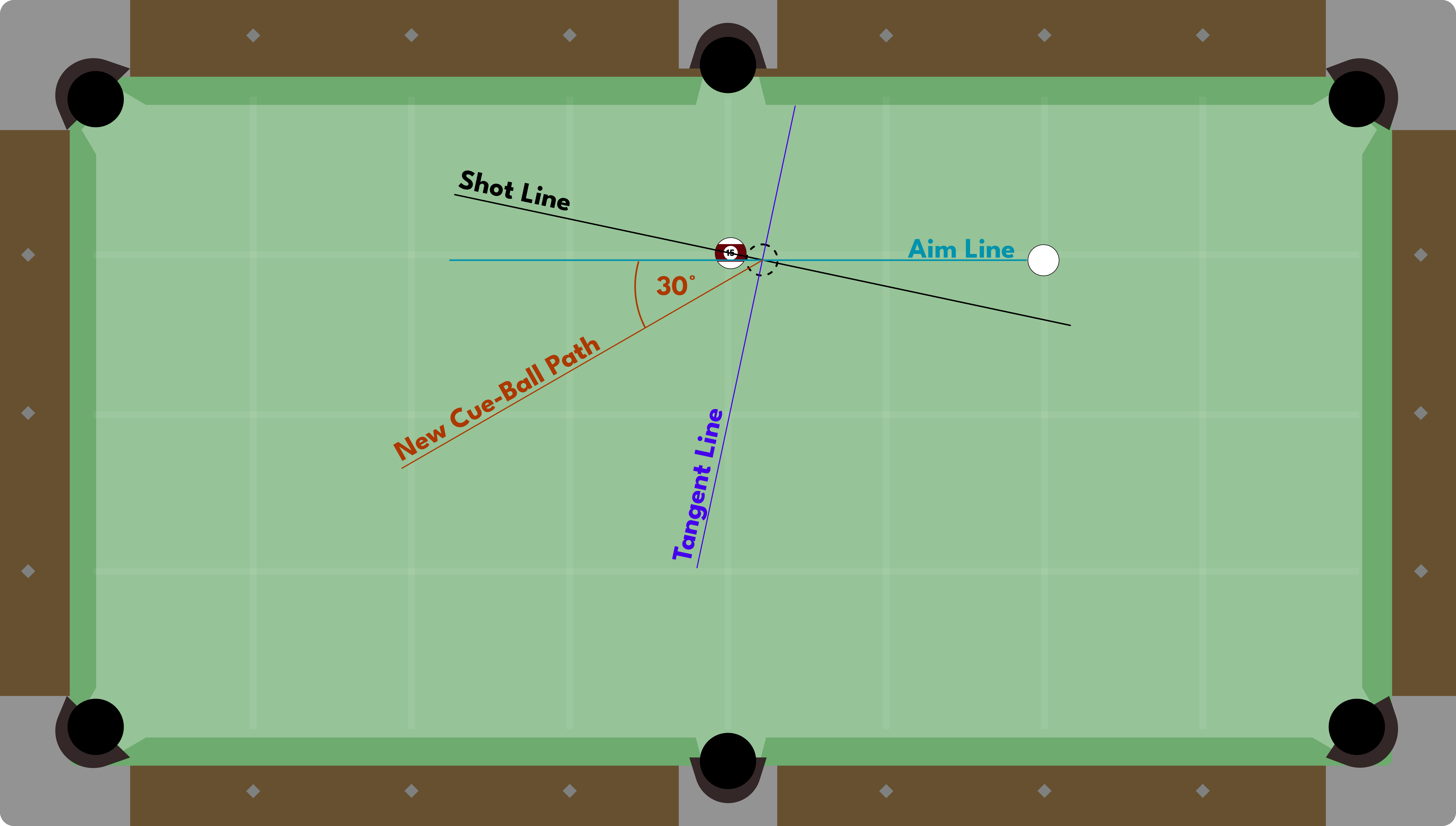
The 30° Rule is an approximation rather than an exact angle. For most common cut shots, a rolling cue-ball will leave the object ball at an angle of approximately 30° from the aim line, making it a reliable reference for predicting cue-ball position. Extremely thin cuts (less than a ¼-ball hit), nearly full hits (greater than a ¾-ball hit), heavy sidespin, or other outside factors may cause the actual angle to differ.
To estimate 30° during a shot, make a peace sign with your index and middle fingers and place the base of your fingers over the . Align one finger with the aiming line in a way where the other finger points away from the direction of the cut. For a cut to the left, the second finger will point to the right of the object ball; for a cut to the right, it will point to the left. The second finger provides a close approximation of the cue-ball's new path for a rolling cue-ball.
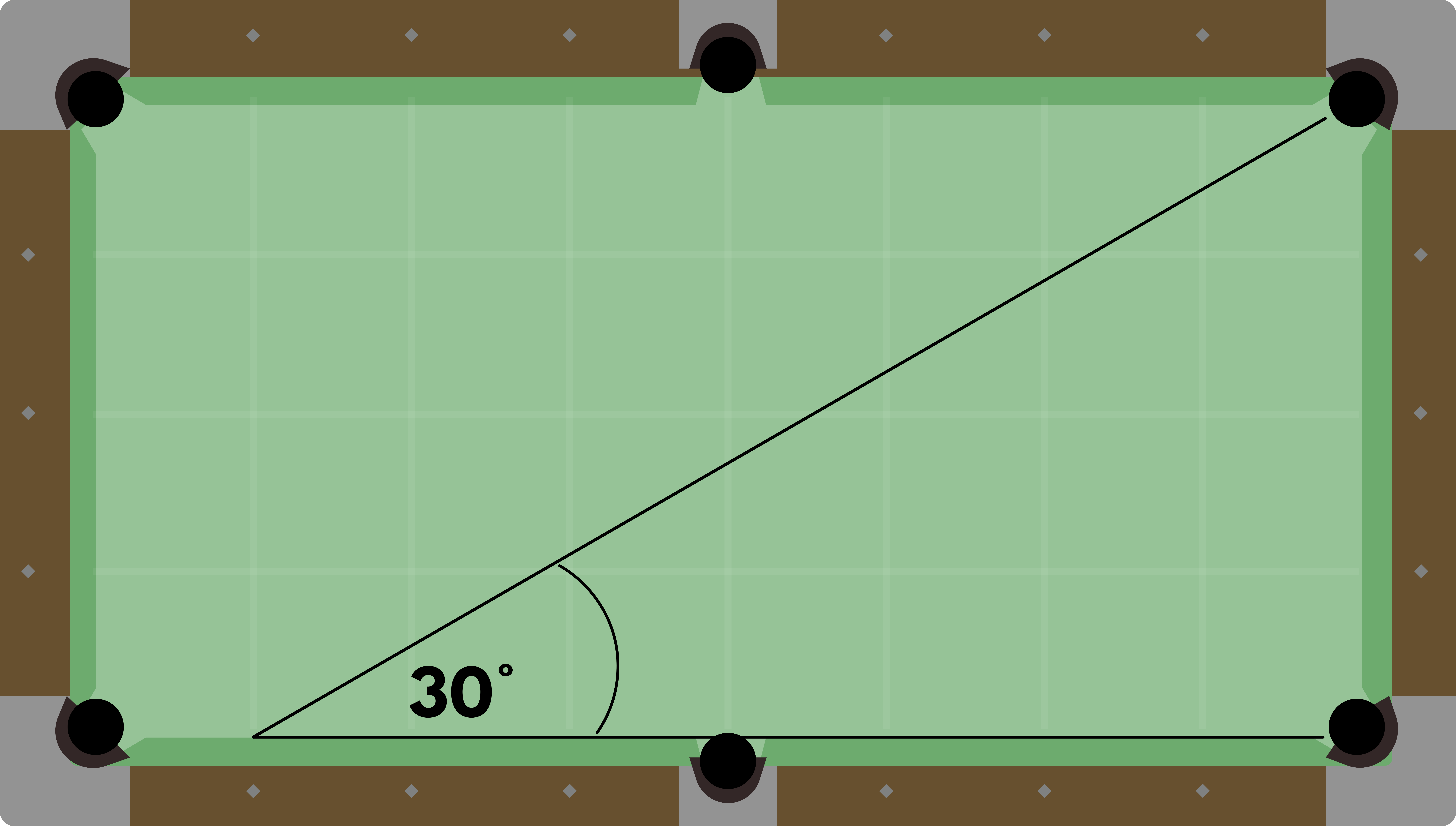
To calibrate your peace sign for the 30° Rule, place one finger along a long rail with the base of your fingers positioned at the first diamond from the short rail. Spread your index and middle fingers until the other finger points directly to the opposite corner pocket. This works on any regulation pool table because the playing surface is twice as long as it is wide, and the diamonds are evenly spaced, making the angle from the first diamond to the opposite corner pocket 30°.
Conclusion
Together, the 90° and 30° Rules provide two important reference points for cue-ball control. A sliding cue-ball follows the tangent line, while a rolling cue-ball follows an approximately 30° path. By understanding which state the cue-ball is in at the moment of impact, you can more accurately predict its path and make better decisions for position play.
Key Points
- The table cloth's friction continuously changes a ball's speed and rotation.
- Every shot can be analyzed using four reference lines: the , , , and .
- The 90° Rule applies when the cue-ball is sliding () at the moment of impact. The cue-ball's new path follows the .
- The 30° Rule applies when the cue-ball is rolling forward at the moment of impact.
- The 30° Rule is an approximation and is less accurate on very thin cuts, very full hits, or when significant sidespin is used.
- For most common cut shots, the cue-ball develops forward roll through friction with the table cloth, making the 30° Rule the most common cue-ball path.
- Understanding the cue-ball's state at impact allows you to predict its path and improve position play.